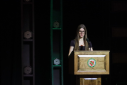


Some moments in a school’s life ask us to look backward. Others ask us to look ahead. Friday’s installation of David G. Perfield as New Hampton School’s 24th Head of School did both.
There was history in the room: the traditions that have carried New Hampton forward since 1821, the former heads and educators who helped shape the School, and the generations of students and families whose lives remain woven into its story. There was also a palpable sense of possibility—the feeling that comes when a community pauses long enough to recognize where it has been, then turns together toward what comes next.
Throughout the afternoon, one idea surfaced again and again: mattering.
To matter is to be seen. To know that your presence makes a difference. To understand that you are part of something larger than yourself—and that what you do, how you show up, and how you care for others has meaning.
It was a fitting theme for Perfield’s installation because it has long been at the center of how he talks about education. For him, schools are built through relationships: the teacher who notices a student, the coach who stays in their corner, the mentor who tells the truth, the friend who shows up, the community that makes room for someone to become more fully themselves.
And it was especially fitting for a leader returning to a place that has shaped so much of his own life.
Perfield first arrived at New Hampton nearly 25 years ago as a classroom teacher, coach, dorm parent, and advisor. He taught Biology, worked in Admissions, and later traveled the globe raising support for the School. After serving as Director of Development and Assistant Head of School at Cardigan Mountain School and as Head of School at Oldfields, he returned to New Hampton in 2022 as Assistant Head of School.
On Friday, surrounded by the people who have been part of his journey—and by the students, colleagues, families, alumni, and friends who will help shape the journey ahead—he accepted the responsibility of leading the School he has long hoped to serve.
The significance of the moment was reflected in the people who gathered to witness it. Joining the New Hampton community were former heads of school Joe and Eileen Williams P’22, Andrew Menke P’12, ’16, and former interim head Alan Crocker P’04, ’07, as well as Chris Day, Head of Cardigan Mountain School (and New Hampton School alumnus, class of 1984), where Perfield served for seven years, and John McVeigh, Head of Holderness School. Their presence offered more than a connection to New Hampton’s past and its Lakes Region neighbors; it underscored the community of educators and leaders who have known Perfield, worked alongside him, and now stand behind him as he takes on this role.

A Homecoming of Spirit and Heart
For Suzanne Walker Buck, who served at New Hampton before going on to become a head of school herself, returning to campus to speak at the installation was especially meaningful. She described the day as a “homecoming of the spirit and heart.”
Buck centered her remarks on the idea of collective effervescence—the energy and heightened sense of meaning that occurs when people who share values and purpose come together. “Being in the company of others is completely different than watching alone on a screen,” Buck said. “It is so much more powerful, more meaningful, more joyful, to share an experience.”
She connected that idea to Perfield’s leadership, recalling a story from their time together in New Hampton’s Admissions Office. A simple misunderstanding over the phrase “admission package” led to an accidentally premature acceptance of a prospective student—but also to a lesson in the importance of shared language.
When Perfield learned what had happened, he suggested that the office develop “a shared meaning of language.” The story, Buck said, captured something essential about the leader she had come to know: someone direct and honest, deeply committed to excellence, and willing to address what needed to be improved because the work—and the people doing it—mattered.
“Words have meaning and actions matter,” she said. “David Perfield leads with an understanding of the importance and meaning of both.”
She invited the community to affirm him in return, leading a playful call-and-response that moved from “David” to “Perfield” and, eventually, to the affectionate admission that he is “a little bit of a nerd but we love him anyway.”
It was an exchange that captured something essential about the afternoon. This was a formal ceremony, but it was also deeply personal.

The People Who Make Us Who We Are
That sense of belonging continued as Perfield’s daughters, Lexi and Anna ’29, offered their own portraits of their dad.
Lexi read Edgar Albert Guest’s “It Couldn’t Be Done,” a poem about persistence and the willingness to try what others say cannot be done. She explained that those ideas reflect what her father has taught her: work hard, keep going, try again—and remember to have fun along the way.
Anna spoke not about the Head of School, but about her dad. “He has taught me what it means to work hard, care about other people, and give your best to the things that matter,” she said.
She described someone who shows up, who works hard, who is a relentless cheerleader for the people he loves. She talked about his goofy side, his fun socks and dad jokes, but also about the deeper lesson he has modeled for her: that success is measured by more than accomplishments. It is measured by the people we love, the relationships we build and the difference we make.
For the Perfield family, New Hampton has long been more than a school. It has been home. Lisa is an alumna of the Class of 2001, Lexi looks ahead to her own journey, and Anna’s experience as a New Hampton student has woven another generation into that story. David has spent his career talking about the importance of showing up for young people; here, his family offered a glimpse of the people who have shown up for him.
A Brick, Carried Forward
As a tangible symbol of that responsibility, Board Chair Clare Rothschild presented Perfield with a brick from Randall Hall, New Hampton’s original dormitory.
Built in 1829 near the Town House, Randall Hall was dismantled when the School moved to its present Smith Village campus in the 1850s. Rather than leave it behind, New Hampton’s predecessors carried the building—brick by brick, by ox cart—to its new home at the heart of campus.
The story offered a fitting metaphor for the moment.
“This school has always valued its beginnings enough to carry them forward,” Rothschild said. “New Hampton was built for the long haul and has stayed strong through change.”
The brick also established a new tradition. Fitted with a brass plate marking the authority of the Head of School, it will now pass from one head to the next at each future installation. Perfield became its first recipient.

“This Isn’t About Me—This Is About Us”
In accepting the headship, Perfield acknowledged that he, too, was shaped by the people who came before him. He spoke of mentors, colleagues, former students, friends, family members, coaches, and educators who opened doors, offered honest counsel, challenged him to grow, and helped him see possibilities in himself that he could not yet see.
“For nearly two decades, I have carried the dream of one day serving as Head of School at New Hampton,” he said. “Reaching this moment required persistence, patience, hard work, and opportunities I have never taken for granted. More importantly, it required people.”
That recognition became a central theme of his remarks.
“As I stand before you today, I am mindful that the leadership of this School does not belong to any one person,” Perfield said. “It is entrusted to each Head of School for a period of time, along with the responsibility to honor those who came before, care deeply for the School and its people today, and prepare New Hampton for those who will follow.”
In his inaugural remarks, Perfield returned repeatedly to the people at the heart of New Hampton. His vision begins with a simple premise: students should know that they matter.
“Every student should know that they are seen, valued, and capable of making a meaningful contribution,” he said.
That belief is inseparable from New Hampton’s mission and core values of Respect and Responsibility. The School’s purpose is not simply to prepare students academically, but to create the conditions in which young people can discover their strengths, develop confidence, think critically, and use their talents in service to others.
For Perfield, that work depends on relationships. Students may not remember every lesson they are taught, he said, but they remember the adults who noticed them, challenged them, believed in them, and built meaningful relationships with them.
He challenged students to dream boldly, build circles of people who will believe in them and tell them the truth, and become those people for others. “Encourage their dreams. Hold them accountable. Celebrate their progress. Stay in their corner when the path becomes uncertain,” he shared.
That commitment to being present—to “be where my feet are”—will also define Perfield’s leadership. He pledged to lead with conviction and collaboration, listen carefully, communicate with honesty and transparency, empower others to lead, and hold himself accountable.
And while the work ahead is serious, he intends to make room for joy.
Drawing on lessons from training for and completing Ironman triathlons, Perfield spoke about endurance, focus, adversity, rest, and perspective. He also promised to bring his sense of humor to the work and to celebrate the victories along the way.
Looking ahead, Perfield acknowledged the challenges facing independent schools, from shifting enrollment patterns and rising costs to increased competition, evolving student needs, and the rapid development of artificial intelligence. Yet he described New Hampton as entering its next chapter from a position of genuine strength.
The Board has charged him with developing a multi-year strategic plan centered on Purpose, Performance, and Possibility—one that honors the core experience and culture of New Hampton while identifying where the School must evolve, invest, and innovate. The broader community will have an opportunity to engage with that vision over the coming year.
“We will honor our history by continuing to evolve for our students,” Perfield said. “Tradition anchors us; progress moves us forward.”
Ultimately, though, Perfield’s vision is less about a destination than about the people who will make the journey together.
“My ambition is for New Hampton to be known as a school that prepares its graduates not only for college, but for the personal and professional journeys that follow,” he said.
He accepted the responsibilities of the headship with “gratitude, humility, confidence, and love” for the School. And he offered a clear measure for the chapter ahead: not what one person accomplishes, but what a community builds together. “I want my legacy within this School’s history to reflect the strength of what we accomplished together and the care with which we prepared New Hampton for generations to come.”
There is a particular kind of optimism that belongs to a beginning—not the optimism that assumes the road ahead will be easy, but the kind that comes from knowing you will not walk it alone. That spirit ran through Friday’s celebration. It was there in the presence of former heads and colleagues. It was there in the voices of Perfield’s daughters. It was there in the Randall Hall brick, carried forward from one generation to another. And it was there in a community gathered not simply to witness a new headship, but to affirm its willingness to take part in what comes next.
The work of this next chapter is underway.
New Hampton’s history will continue to be carried forward—not unchanged, but with care. Its traditions will continue to provide a foundation, even as the School considers new possibilities for its students. And its future will be shaped, as its past has been, by the people who choose to show up for one another.
“This isn’t about me—this is about us,” Perfield said.
For a school built to last, perhaps there is no better way to begin.